Las Hormigas epígeas (Hymenoptera: Formicidae) como bioindicadores de perturbación en suelos para los valles secos interandinos (Sucre, Bolivia)
Epigaeic ants (Hymenoptera: Formicidae) as bioindicators of degraded soil in the inter-andean dry valleys (Sucre, Bolivia)
DOI:
https://doi.org/10.56469/rae.v5i1.2326Palabras clave:
Cobertura Forestal, Diversidad, Monte Willca, PerturbaciónResumen
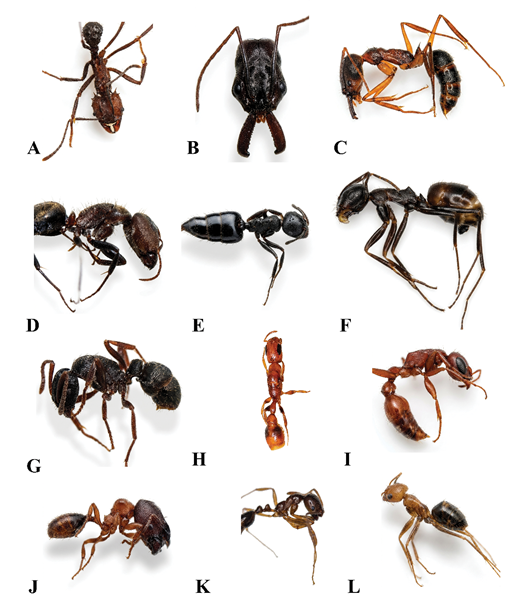
Este estudio evalúa la diversidad y composición de hormigas epigeas (Formicidae) como bioindicadores de perturbación del suelo en el Área Protegida Monte Willca (Sucre, Bolivia), considerando tres niveles de perturbación: sin perturbar (SP), semi perturbado (SMP) y perturbado (EP). Las hormigas fueron recolectadas mediante trampas de caída y se analizaron propiedades fisicoquímicas del suelo (conductividad eléctrica, materia orgánica y capacidad de intercambio catiónico), además de la cobertura vegetal. Los resultados mostraron que el área SP presentó la mayor diversidad (índice de Shannon: 1,31) y equitatividad, con predominio de los géneros Pheidole y Dorymyrmex. En el área SMP se observó una diversidad intermedia y mayor heterogeneidad, mientras que el área EP mostró una marcada dominancia de géneros tolerantes al estrés, como Solenopsis y una riqueza más baja. La degradación del suelo en EP se relacionó con una mayor salinidad (0,31 dS/m) y baja materia orgánica (0,17%). Los análisis de componentes principales (PCA) y las matrices de correlación evidenciaron asociaciones entre la fertilidad del suelo, la cobertura vegetal y la diversidad de hormigas. Estos resultados destacan el potencial de las hormigas epígeas como bioindicadores efectivos del estado del suelo y refuerzan la importancia de implementar estrategias de manejo sostenible en ecosistemas áridos y frágiles.
Citas
Bannayan, M., Tojo Soler, C. M., Garcia y Garcia, A., Guerna, L. C., Abe, T., & Higashi, M. (2001). Isoptera. In Encyclopedia of Biodiversity: Second Edition (Vol. 4). Elsevier Ltd. https://doi.org/10.1016/B978-0-12-384719-5.00200-8
Agosti Donat, Majer Jonathan, A. L. and S. T. (2000). Sampling Ground-dwelling Ants: Case Studies from the Worlds’ Rain Forests (L. A. and T. S. Donat Agosti, Jonathan Majer (ed.)).
Andersen, A. N., & Majer, J. D. (2004). Ants show the way Down Under: management. Front Ecol Environ, 2(6), 291–298.
Antoniazzi, R., Ahuatzin, D. A., Pelayo-Martínez, J., Ortiz-Lozada, L., Leponce, M., & Dáttilo, W. (2020). On the effectiveness of hand collection to complement baits when studying ant vertical stratification in tropical rainforests. Sociobiology, 67(2), 213–222. https://doi.org/10.13102/sociobiology.v67i2.4909
Baied, C. A., & Wheeler, J. C. (1993). Evolution of high Andean puna ecosystems: environment, climate, and culture change over the last 12 000 years in the central Andes. Mountain Research & Development, 13(2), 145–156. https://doi.org/10.2307/3673632
Bal, L. (1982). Zoological ripening of soils. I. The concept and impact in pedology, forestry and agriculture. II. The process in two Entisols under developing forest in a recently reclaimed Dutch polder. 377.
Barrera, C. A., Sosa-Calvo, J., Schultz, T. R., Rabeling, C., & Bacci, M. (2022). Phylogenomic reconstruction reveals new insights into the evolution and biogeography of Atta leaf-cutting ants (Hymenoptera: Formicidae). Systematic Entomology, 47(1), 13–35. https://doi.org/10.1111/syen.12513
Basset, Y. (2001). Invertebrates in the canopy of tropical rain forests: How much do we really know? Plant Ecology, 153(1–2), 87–107. https://doi.org/10.1023/A:1017581406101
Bolton, B. (1994). Identification Guide to the Ant Genera of the World - Barry Bolton.pdf (p. 226).
Bolton, B. (1995). A taxonomic and zoogeographical census of the extant ant taxa. Journal of Natural History, 29, 1037–1056.
Brady, N. C., & Weil, R. R. (2008). The Soils Around Us Overview. The Nature and Properties of Soils, 5(6), 1–16.
Breshears, D. D., Cobb, N. S., Rich, P. M., Price, K. P., Allen, C. D., Balice, R. G., Romme, W. H., Kastens, J. H., Floyd, M. L., Belnap, J., Anderson, J. J., Myers, O. B., & Meyer, C. W. (2005). Regional vegetation die-off in response to global-change-type drought. Proceedings of the National Academy of Sciences of the United States of America, 102(42), 15144–15148. https://doi.org/10.1073/pnas.0505734102
Brussaard, L. (1997). Biodiversity and Ecosystem Functioning in Soil. December 1992, 563–570.
Buesa, E. (2010). Apuntes de Análisis. 1–71. http://www.eduardobuesa.es/Apuntes-de-Bioestadistica.pdf
Cabrejos, E. F., Alvariño, L., & Iannacone, J. (2019). Diversidad Y Abundancia De Hormigas (Formicidae) En Viviendas De Puente Piedra, Lima, Perú. 9, 145–153. https://doi.org/10.31381/paideia.v9i1.2269
Cammeraat, E. L. H., & Risch, A. C. (2008). The impact of ants on mineral soil properties and processes at different spatial scales. Journal of Applied Entomology, 132(4), 285–294. https://doi.org/10.1111/j.1439-0418.2008.01281.x
Cammeraat, L. H., Willott, S. J., Compton, S. G., & Incoll, L. D. (2002). The effects of ants’ nests on the physical, chemical and hydrological properties of a rangeland soil in semi-arid Spain. Geoderma, 105(1–2), 1–20. https://doi.org/10.1016/S0016-7061(01)00085-4
Catalicio Paredes B. Takanori Igarashi & Morio Chiba. (1986). Metodos de Análisis de Suelos. Agencia de Cooperacion Internacional del Japon.
Chamorro-Martínez, Y., Torregroza-Espinosa, A., Moreno Pallares, M., Osorio, D., Paternina, A., & Echeverría-González, A. (2022). Soil macrofauna, mesofauna and microfauna and their relationship with soil quality in agricultural areas in northern Colombia: Ecological implications. Revista Brasileira de Ciencia Do Solo, 46, 1–15. https://doi.org/10.36783/18069657rbcs20210132
Chanatásig-Vaca, C. I., Huerta Lwanga, E., Rojas Fernández, P., Ponce-Mendoza, A., Mendoza Vega, J., Morón Ríos, A., Van der Wal, H., & Dzib-Castillo, B. B. (2011). Efecto del uso de suelo en las hormigas (Formicidae: Hymenoptera) de Tikinmul, Campeche, México. Acta Zoológica Mexicana (N.S.), 27(2), 441–461. https://doi.org/10.21829/azm.2011.272764
Chazdon, R. L., Broadbent, E. N., Rozendaal, D. M. A., Bongers, F., Zambrano, A. M. A., Aide, T. M., Balvanera, P., Becknell, J. M., Boukili, V., Brancalion, P. H. S., Craven, D., Almeida-Cortez, J. S., Cabral, G. A. L., De Jong, B., Denslow, J. S., Dent, D. H., DeWalt, S. J., Dupuy, J. M., Durán, S. M., … Poorter, L. (2016). Carbon sequestration potential of second-growth forest regeneration in the Latin American tropics. Science Advances, 2(5). https://doi.org/10.1126/sciadv.1501639
Chocobar Guerra, E. A. (2010). Edafofauna como indicador de calidad en un suelo cumulic phaozem sometido a diferentes sistemas de manejos en un experimento de larga duración. In Tesis. (Maestría en Ciencias, Especialista en Edafología).- Colegio de Postgraduados, 2010. http://www.biblio.colpos.mx:8080/jspui/handle/10521/317
Coleman, W. (1986). Evolution into ecology? The strategy of warming’s ecological plant geography. Journal of the History of Biology, 19(2), 181–196. https://doi.org/10.1007/BF00138875
Corwin, D. L. (2021). Climate change impacts on soil salinity in agricultural areas. European Journal of Soil Science, 72(2), 842–862. https://doi.org/10.1111/ejss.13010
Corwin, D. L., & Lesch, S. M. (2005). Apparent soil electrical conductivity measurements in agriculture. Computers and Electronics in Agriculture, 46(1-3 SPEC. ISS.), 11–43. https://doi.org/10.1016/j.compag.2004.10.005
Cuesta, F., Peralvo, M., Merino-Viteri, A., Bustamante, M., Baquero, F., Freile, J. F., Muriel, P., & Torres-Carvajal, O. (2017). Priority areas for biodiversity conservation in mainland Ecuador. Neotropical Biodiversity, 3(1), 93–106. https://doi.org/10.1080/23766808.2017.1295705
D. U. Hooper, F. S. Chapin, III, J. J. Ewel, A. H., P. Inchausti, S. L., J. H. Lawton, D. M. Lodge, M. Loreau, S. Naerm, B. Schmid, H. Setala, & A. J. Symstad, J. Vandermeer, A. D. A. W. (2005). Effects of biodiversity on ecosystem functioning: A Consensus of current knowledge. Science, 305(5687), 1101. https://doi.org/10.1126/science.305.5687.1101
Da Silva Dias, N., Zanetti, R., Santos, M. S., Villalba Peñaflor, M. F. G., Forti Broglio, S. M., & Charles Delabie, J. H. (2013). The impact of coffee and pasture agriculture on predatory and omnivorous leaf-litter ants. Journal of Insect Science, 13(29), 1–11. https://doi.org/10.1673/031.013.2901
Decaens. T, Jiménez J. J, Rangel A. F, Cepeda A, M. A. G. & P. L. (2001). La Macrofauna del Suelo en la Sabana Bien Drenada de los Llanos Orientales. In M. F. Rippstein Georges, Escobar German (Ed.), Agroecología y biodiversidad de las sabanas en los Llanos Orientales de Colombia (pp. 118–135). Colombia, junio de 2001.
Decaëns, T., Mariani, L., & Lavelle, P. (1999). Soil surface macrofaunal communities associated with earthworm casts in grasslands of the Eastern Plains of Colombia. Applied Soil Ecology, 13(1), 87–100. https://doi.org/10.1016/S0929-1393(99)00024-4
DGBAP. (2022). Atlas de las áreas protegidas municipales de Bolivia - 2022.
Diamé, L., Rey, J. Y., Vayssières, J. F., Grechi, I., Chailleux, A., & Diarra, K. (2018). Ants: Major functional elements in fruit agro-ecosystems and biological control agents. Sustainability (Switzerland), 10(1), 1–18. https://doi.org/10.3390/su10010023
Dlamini, P., Chivenge, P., & Chaplot, V. (2016). Overgrazing decreases soil organic carbon stocks the most under dry climates and low soil pH: A meta-analysis shows. Agriculture, Ecosystems and Environment, 221, 258–269. https://doi.org/10.1016/j.agee.2016.01.026
Durán, A., Morrás, H., Studdert, G., & Liu, X. (2011). Distribution, properties, land use and management of Mollisols in South America. Chinese Geographical Science, 21(5), 511–530. https://doi.org/10.1007/s11769-011-0491-z
Eckholm, E. P. (1975). The deterioration of mountain environments. Science, 189(4205), 764–770. https://doi.org/10.1126/science.189.4205.764
Elizabeth, M., & Correia, F. (2001). Diversity and functional role of soil macrofauna Agrobiology. Transport, 8–10. http://unu.edu/env/plec/cbd/abstracts/Brown.doc
Emery, C. (1894). Estudios sobre las hormigas de Costa Rica. In An. Mus. Nac. Costa Rica (Vols. 1888–1889, pp. 45–64, lamina I & II).
Etter, A., McAlpine, C., & Possingham, H. (2008). Historical patterns and drivers of landscape change in Colombia since 1500: A regionalized spatial approach. Annals of the Association of American Geographers, 98(1), 2–23. https://doi.org/10.1080/00045600701733911
F. Montagnini and P.K.R.Nair. (2004). Carbon sequestration: An underexploited environmental benefit of agroforestry systems. 34(October 2004). https://doi.org/10.1023/B
Farji-Brener, A. G. (1992). Modificaciones al suelo realizadas por hormigas cortadoras de hojas ( Formicidae , Attini ): una revisión de sus efectos sobre la vegetación. Ecología Austral, 2(1973), 87–94.
Fernandez, F. (2003). Introducción a las Hormigas de la región Neotropical. In F. F. (Ed.), Instituto de Investigación de Recursos Biologicos Alexander von Humboldt. http://repository.humboldt.org.co/bitstream/handle/20.500.11761/32961/978-958-8151-23-6.pdf?sequence=1&isAllowed=y#page=149
Ferreira, J. N., Barlow, J., Lennox, G. D., Ferreira, J., Berenguer, E., Lees, A. C., Nally, R. Mac, Ribeiro, R., Solar, D. C., Vieira, I. C. G., & Aragao, L. E. O. . (2016). Anthropogenic disturbance in tropical forests can double biodiversity loss from deforestation. Nature, 535(7610), 144.
Fitter, A. H., Gilligan, C. A., Hollingworth, K., Kleczkowski, A., Twyman, R. M., & Pitchford, J. W. (2005). Biodiversity and ecosystem function in soil. Functional Ecology, 19(3), 369–377. https://doi.org/10.1111/j.0269-8463.2005.00969.x
Foley, J. A., DeFries, R., Asner, G. P., Barford, C., Bonan, G., Carpenter, S. R., Chapin, F. S., Coe, M. T., Daily, G. C., Gibbs, H. K., Helkowski, J. H., Holloway, T., Howard, E. A., Kucharik, C. J., Monfreda, C., Patz, J. A., Prentice, I. C., Ramankutty, N., & Snyder, P. K. (2005). Global consequences of land use. Science, 309(5734), 570–574. https://doi.org/10.1126/science.1111772
Folgarait, P. J. (1998). Ant biodiversity and its relationship to ecosystem functioning: A review. Biodiversity and Conservation, 7(9), 1221–1244. https://doi.org/10.1023/A:1008891901953
Fox, G. A., & Wilson, G. V. (2010). The Role of Subsurface Flow in Hillslope and Stream Bank Erosion: A Review. Soil Science Society of America Journal, 74(3), 717–733. https://doi.org/10.2136/sssaj2009.0319
Fredericksen, N. J., & Fredericksen, T. S. (2002). Terrestrial wildlife responses to logging and fire in a Bolivian tropical humid forest. Biodiversity and Conservation, 11(1), 27–38. https://doi.org/10.1023/A:1014065510554
Frouz, J., & Jilková, V. (2008). The effect of ants on soil properties and processes ( Hymenoptera : Formicidae ). Myrmecological News, 11(August), 191–199.
Gabet, E. J., Reichman, O. J., & Seabloom, E. W. (2003). The effects of bioturbation on soil processes and sediment transport. In Annual Review of Earth and Planetary Sciences (Vol. 31, Issue L, pp. 249–273). https://doi.org/10.1146/annurev.earth.31.100901.141314
García, Y., Ramírez, W., & Sánchez, S. (2012). Indicadores de la calidad de los suelos : una nueva manera de evaluar este recurso. Pastos Y Forrajes, 35(2), 125–137.
GBIF.org. (2023). Global Biodiversity Information Facility. GBIF Occurrence Download.
Gongalsky, K. B. (2021). Soil macrofauna: Study problems and perspectives. Soil Biology and Biochemistry, 159(November 2020), 108281. https://doi.org/10.1016/j.soilbio.2021.108281
Grimaldi & Engel. (2005). EVOLUTION OF THE INSECTS. In Journal of Chemical Information and Modeling (Vol. 53, Issue 9).
Grove, A. T., & Dregne, H. E. (1985). Desertification of Arid Lands. The Geographical Journal, 151(1), 114. https://doi.org/10.2307/633298
Gunstone, T., Cornelisse, T., Klein, K., Dubey, A., & Donley, N. (2021). Pesticides and Soil Invertebrates: A Hazard Assessment. Frontiers in Environmental Science, 9(May), 1–21. https://doi.org/10.3389/fenvs.2021.643847
Gutiérrez-Vélez, V. H., DeFries, R., Pinedo-Vásquez, M., Uriarte, M., Padoch, C., Baethgen, W., Fernandes, K., & Lim, Y. (2011). High-yield oil palm expansion spares land at the expense of forests in the Peruvian Amazon. Environmental Research Letters, 6(4), 044029. https://doi.org/10.1088/1748-9326/6/4/044029
Haddad, N. M., Brudvig, L. A., Clobert, J., Davies, K. F., Gonzalez, A., Holt, R. D., Lovejoy, T. E., Sexton, J. O., Austin, M. P., Collins, C. D., Cook, W. M., Damschen, E. I., Ewers, R. M., Foster, B. L., Jenkins, C. N., King, A. J., Laurance, W. F., Levey, D. J., Margules, C. R., … Townshend, J. R. (2015). Habitat fragmentation and its lasting impact on Earth’s ecosystems. Science Advances, 1(2), 1–9. https://doi.org/10.1126/sciadv.1500052
Hamza, M. A., & Anderson, W. K. (2005). Soil compaction in cropping systems: A review of the nature, causes and possible solutions. Soil and Tillage Research, 82(2), 121–145. https://doi.org/10.1016/j.still.2004.08.009
Herzog, S. K., Soria Auza, R. W., & Hennessey, A. B. (2005). Ecoregional patterns of richness, endemism and threat of the Bolivian avifauna: priorities for ecoregional planning. Ecología En Bolivia, 40(2), 27–40.
Higashi, M., Abe, T., & Burns, T. P. (1992). Carbon-nitrogen balance and termite ecology. Proceedings of the Royal Society B: Biological Sciences, 249(1326), 303–308. https://doi.org/10.1098/rspb.1992.0119
Hillebrand, H., Blasius, B., Borer, E. T., Chase, J. M., Downing, J. A., Eriksson, B. K., Filstrup, C. T., Harpole, W. S., Hodapp, D., Larsen, S., Lewandowska, A. M., Seabloom, E. W., Van de Waal, D. B., & Ryabov, A. B. (2018). Biodiversity change is uncoupled from species richness trends: Consequences for conservation and monitoring. Journal of Applied Ecology, 55(1), 169–184. https://doi.org/10.1111/1365-2664.12959
Hinsinger, P., Bengough, A. G., Vetterlein, D., & Young, I. M. (2009). Rhizosphere: Biophysics, biogeochemistry and ecological relevance. Plant and Soil, 321(1–2), 117–152. https://doi.org/10.1007/s11104-008-9885-9
Hoffmann, B. D. (2000). Changes in ant species composition and community organisation along grazing gradients in semi-arid Rangelands of the Northern Territory. Rangeland Journal, 22(2), 171–189. https://doi.org/10.1071/RJ0000171
Hoffmann, B. D. (2010). Using ants for rangeland monitoring: Global patterns in the responses of ant communities to grazing. Ecological Indicators, 10(2), 105–111. https://doi.org/10.1016/j.ecolind.2009.04.016
Hoffmann, B. D., Abbott, K. L., & Davis, P. (2010). Invasive Ant Management. Ant Ecology. https://doi.org/10.1093/acprof:oso/9780199544639.003.0016
Hoffmann, B. D., Griffiths, A. D., & Andersen, A. N. (2000). Responses of ant communities to dry sulfur deposition from mining emissions in semi-arid tropical Australia, with implications for the use of functional groups. Austral Ecology, 25(6), 653–663. https://doi.org/10.1111/j.1442-9993.2000.tb00071.x
Hole, F. D. (1981). as a part of the equipment of inhabiting animals as they function as " survival machines " that assure " immortality " to those " duplicating machines " called genes ( Dawkins , 1976 ). Pedologists may characterize in their profile descriptions the fabric. 25.
Holl, K. D., & Aide, T. M. (2011). When and where to actively restore ecosystems? Forest Ecology and Management, 261(10), 1558–1563. https://doi.org/10.1016/j.foreco.2010.07.004
Ibisch, P. L., Beck, S. G., Gerkmann, B., & Carretero, A. (2003). Ecoregiones